
Lincoln County Kansas VINE
Kansas VINE is the statewide custody-status and notification service reached through VINELink. Lincoln County participation is not just a broad statewide assumption. The Lincoln County Sheriff’s official page links Kansas VINE, publishes its telephone number, and describes custody-status checks plus automated telephone or email notifications.
Coverage has a firm boundary. Kansas Attorney General materials state that VINE covers adults held in participating Kansas county jails and excludes offenders housed in KDOC state prisons. Thus, a Lincoln County Jail custody record belongs in Kansas VINE. A person serving a state-prison sentence must be checked through KASPER and KDOC instead. Federal, immigration, juvenile, hospital, out-of-state, and some municipal custody systems also require their own sources.
Search Lincoln County VINELink
Open the Kansas VINELink portal and search one person. Use the most accurate name or available identifier. Name-only results can be ambiguous, so compare the agency, age or birth details when shown, and any record identifier before selecting a match. Search spelling variants cautiously. A similar name is not enough.
- Open Kansas in VINELink and choose the person or offender search.
- Enter the full name or available ID, using the committed spelling when known.
- Review possible matches and compare every identifier the live result provides.
- Open the record and read the current custody status, facility or agency, and update information.
- If the result reports release or out of custody, contact the displayed custodian or Lincoln County Sheriff for the release or transfer entry.
The official Kansas entry screen shows where a specific-person search and notification registration begin.
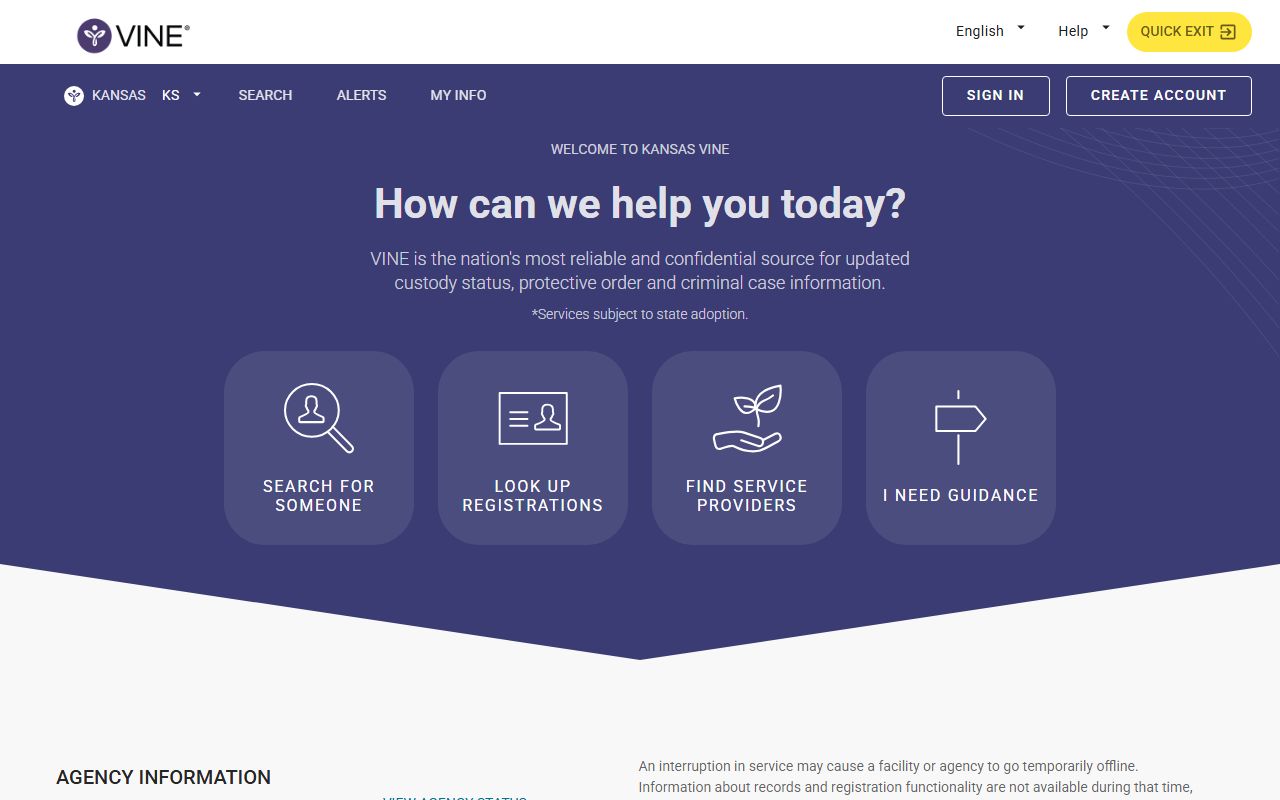
The portal is the alert channel, while the sheriff’s booking record remains the source for the local release reason and destination.
Lincoln County VINE Results
Read only fields actually displayed on the selected live record. VINE can report a custody status and the facility or agency supplying the data. It may also show identifying details and an update point. Public fields can change with the source feed, so the proper wording is “check the record for” rather than a promise that every result carries every field.
| Field | What it can establish | What it cannot establish alone |
|---|---|---|
| Name and identifiers | Which reported custody record was selected | Identity without comparison to other facts |
| Custody status | The reporting agency’s current VINE status | The legal reason for release |
| Facility or agency | Who supplied or held the reported custody | Where the person went after a transfer |
| Update information | How current the displayed feed appears | Real-time physical departure |
| Notification control | Whether registration is offered for that record | A guaranteed delivery time |
A released or out-of-custody result confirms that the reporting custody record changed. It may not state the street-release time, legal authority, next destination, or later custody. If Lincoln County released the person to KDOC, another jail, a warrant, or a detainer, county custody ended but community release did not occur.
The court case answers a different question. A Lincoln County docket may show bond, dismissal, sentencing, or another order that authorized release. It does not supply the sheriff’s exact physical processing time. Compare both sources when the reason matters. If the record names a receiving agency, continue the search in that agency’s system instead of treating “out of custody” as the end of confinement.
Register Lincoln County Release Alerts
Register while the matching person remains available in the system. Select “Get Notifications” or the equivalent current control, then choose an offered channel. Phone and email are documented for Lincoln County through the sheriff’s description. Current Kansas materials also identify text, TTY, and mobile options where offered. Those are VINE services, not a Lincoln County sheriff app.
- Open the verified person record and select the notification control.
- Choose telephone, email, or another channel the live record offers.
- Enter and confirm the phone number or email address.
- For a phone alert, create a four-digit PIN. It is not the person’s booking number.
- Complete any email verification or on-screen confirmation required by VINE.
- Save the registration confirmation and update the registration if contact details change.
When a telephone alert arrives, listen to the message and enter the four-digit PIN followed by the pound key. The official brochure says calls that are unanswered or not confirmed may repeat for up to 24 hours. Email registration uses no PIN and sends one change email. A PIN acknowledges the call; it does not unlock a custody record.
Note: Keep the VINE confirmation because a later name search may become harder after the active Lincoln County custody display changes.
Registration is confidential within the service, but delivery still depends on the contact channel. Keep the phone active, make sure voicemail can receive a call, and watch for the email verification step. If a notification does not arrive when expected, return to the person record and contact the holding agency. Do not infer that silence means custody continued or ended.
Lincoln County VINE Connection
The Lincoln County Sheriff embeds both the VINE explanation and the state portal route. It also publishes the repeatedly corroborated toll-free line, 1-866-574-8463, also rendered as 1-866-KS-4-VINE. Official materials list TTY at 1-866-847-1298. One current Attorney General page transposes digits in the main number, so the number repeated by the sheriff, brochure, and other official material is the supported one.
This local connection makes Kansas VINE the county’s public alert layer, but not the final release ledger. Call the sheriff after an alert and ask whether the booking closed as community release or transfer. The distinction is vital. A transfer to another county or KDOC can produce a Lincoln County custody change while confinement continues elsewhere.
Ask for the person by full name and provide the booking number when known. Request the existing release or transfer entry, including the recorded date, time, code, and receiving agency. If staff cannot provide it by phone, use a Kansas Open Records Act request directed to the sheriff’s custodian. A narrow one-booking request is clearer than a broad demand for all jail material.
Kansas VINE
Online: VINELink Kansas
Telephone: 1-866-574-8463
TTY: 1-866-847-1298
Lincoln County Custody Systems
A failed VINE search can mean the person is outside its Kansas county-jail scope. It can also reflect spelling, timing, feed coverage, or a record that is no longer active. Choose the next system based on the known custody path, not by repeating a name search across unrelated databases.
| Custody type | Correct search route | Release meaning |
|---|---|---|
| Lincoln County Jail adult | Kansas VINE, sheriff record, and court case | Confirm community release versus transfer |
| KDOC state prisoner | KASPER and KDOC records | Distinguish prison release, supervision, and final discharge |
| Federal sentenced prisoner | BOP Inmate Locator | Released means departure from BOP custody |
| USMS pretrial custody | Federal court and case-based USMS route | Absence from BOP is inconclusive |
| ICE custody | ICE Online Detainee Locator and ERO | County release may only be an ICE transfer |
For a state-prison record, use the KASPER search form. For a federal sentence, the BOP locator can show “Released,” a date, or “Not in BOP Custody,” but that last phrase does not prove community release. ICE’s locator is designed for qualifying current custody and certain recent releases, not a permanent release archive.
The Kansas Bureau of Investigation registry is another separate system. It applies only to people with a current statutory duty to register for covered offenses. Presence does not mean the person is now in custody, and absence does not prove release or sentence completion. It cannot replace VINE, the sheriff’s release entry, or KASPER.
Confirm Lincoln County VINE Alerts
VINE notifications depend on data sent by participating agencies. They can be delayed or affected by feed changes. Never schedule an exact pickup, assume a court obligation changed, or infer a transfer destination from the alert alone. Contact the Lincoln County Sheriff or the facility displayed in the record.
If the person has already dropped from an active display, request the existing booking and release entry. Ask for the booking number, release or transfer date and time, code or reason, releasing facility, and receiving agency or destination if recorded. The Lincoln County release-record search describes the sheriff, court, KASPER, and records-request paths for a past event.
Compare the court case when the reason matters. A docket can show bond, dismissal, sentencing, or another release authority, while the sheriff record establishes physical processing. If the VINE status and sheriff entry disagree, note the time each source was updated and obtain direct confirmation from the record owner.
A past alert should be documented with the confirmation details and the agency record. Save the person’s stable identifier, not just a screen name. If a public record contains an error, contact the office that created it with the identifier and exact field at issue. VINELink can report the feed, but the sheriff or other custodian controls the underlying custody record.
For a recent Lincoln County change, ask whether the record was release, transfer, or another booking closure. Then compare the time on the sheriff entry with the VINE update. A later court order can explain the legal authority, while a receiving-agency result can show that custody continued. These checks are more reliable than trying to infer the whole event from one status word.
Use alerts as one part of a verification plan. Keep the toll-free number and the jail contact available, especially if online access fails. When the person is in KDOC custody, stop using VINE and move to KASPER. When the record points outside Kansas county jail custody, follow the named receiving system. Matching the search to the custodian is the key to reading a release alert correctly.