
Lincoln County Release Estimates
A projected date is a calculation based on the sentence record as it stands now. An actual release is the event recorded when the holding agency ends its custody. Those dates can differ. A future KASPER field may reflect sentence credits and current administrative data, but it does not account for every later court order, forfeiture, warrant, or transfer until the record is updated.
Pretrial custody is different. A person held in Lincoln County Jail before disposition does not have a fixed sentence-completion date. Release may depend on bond, dismissal, a plea, sentencing, or another court ruling. Even after the judge acts, the sheriff must complete physical processing and check for other holds.
| Date or event | What it establishes | Best source |
|---|---|---|
| Projected prison date | Current KDOC sentence estimate | KASPER or KDOC sentence record |
| Parole eligibility | First possible board-review point in an eligible case | Statute, sentence, and PRB record |
| Court release order | Legal authority for county release | Lincoln County court case |
| Actual release time | When the holding agency ended custody | Sheriff or KDOC movement record |
Find Lincoln County Projected Release
Start by identifying the custody system. KASPER is the Kansas Adult Supervised Population Electronic Repository and is the proper state route for many KDOC prison and supervision records. It is not a calculator for a term served only at Lincoln County Jail. The person’s committed name, KDOC number, conviction county, and case facts help separate similar records.
- Determine whether the person is pretrial, serving a county-jail sentence, or serving a KDOC prison sentence.
- For KDOC custody, accept the KASPER disclaimer and use the offender search.
- Open the individual record and read the exact status and label beside any release-related date. Do not detach a date from its label.
- For a Lincoln County Jail term, obtain the signed sentencing journal entry, commencement date, jail credit, and concurrent or consecutive structure.
- Ask KDOC or the sheriff and court to reconcile any conflict, then confirm the actual event on the expected day.
KASPER may retain state conviction, sentence, status, date, and photograph details after physical release. That makes it more useful for a former state prisoner than a current county roster. Yet public fields vary by sentence type and record. The Lincoln County release-record path covers the sheriff and court records needed when the person was held locally.
For formal confirmation, KDOC’s main office is at 714 SW Jackson, Suite 300, Topeka, KS 66603, telephone (785) 296-3317. Its contacts page lists the Records Division at (785) 746-7470. A request should identify the person by KDOC number and seek an existing sentence-computation sheet or public movement record. That is more reliable than asking staff to create a new release estimate from incomplete facts.
Lincoln County KASPER Dates
The live individual record controls the field label. Research confirmed that KASPER and KDOC records can carry release-related dates, but no single projected-date label was verified across every record class. If the selected record does not display one, contact KDOC rather than calculating a date from a search-result snippet. A precise request can seek the sentence-computation sheet, custody history, actual release date and type, supervision start, or maximum-sentence discharge record.
Read current status first. “Released from prison to postrelease supervision” does not mean fully discharged from KDOC. An old conviction with a finished sentence does not prove current supervision. Parole eligibility also is not a scheduled departure. It means the Prisoner Review Board may consider an eligible older sentence at that threshold.
The official KASPER entry and disclaimer shows why the public result must be read with its limits.
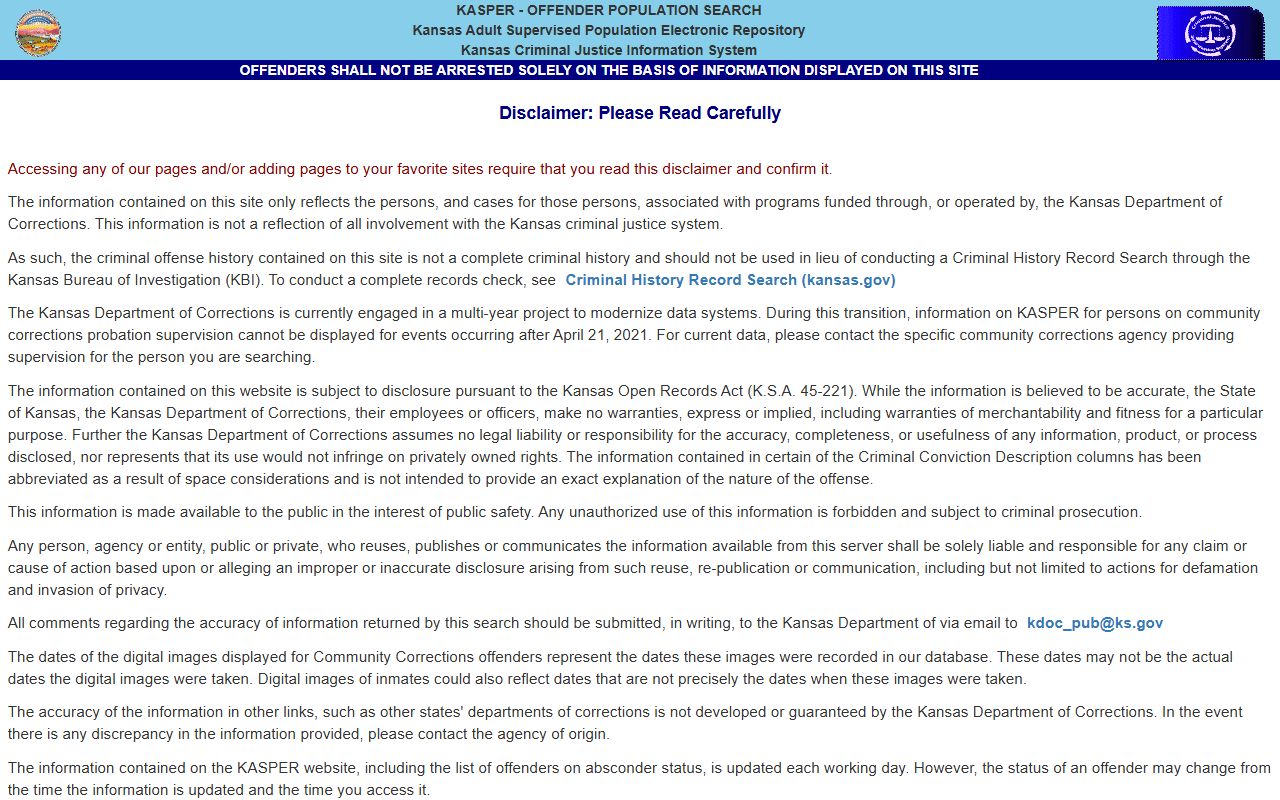
The captured state page supports starting with an exact identity match before interpreting any release date.
Kansas Prison Release Calculation
For a sentencing-guidelines prison term, begin with the journal entry’s prison portion and postrelease term. Apply the court’s jail-credit award. Then determine whether multiple sentences run concurrently, at the same time, or consecutively, one after another. KDOC applies the correct credit rules to that legal structure and maintains the administrative sentence record.
K.S.A. 21-6821 governs modern good-time and program credits. For crimes committed on or after July 1, 1993, subsection (b)(2)(A) permits up to a 15 percent reduction of the prison part. Specified lower-severity nondrug crimes committed on or after January 1, 2008 may receive up to 20 percent under subsection (b)(2)(B). Subsection (b)(2)(C) provides a 20 percent ceiling for specified drug-severity and offense-date groups. Credits must be earned and can be forfeited.
The familiar “serve 85 percent” phrase is only shorthand for a sentence subject to the 15 percent ceiling when all available credit is earned and retained. It is not a universal Kansas rule. Program credits have their own eligibility limits, exclusions, and caps. Certain sexual-offense rules apply earned time to postrelease supervision rather than simply erasing the obligation.
- Good time
- Credit earned under law and KDOC rules that can reduce the prison portion or affect discharge.
- Jail credit
- Time the sentencing court credits toward the sentence for qualifying prior custody.
- Concurrent
- Sentences run at the same time.
- Consecutive
- One sentence runs after another.
Older Kansas Release Dates
Crimes committed before July 1, 1993 and indeterminate sentences follow an older framework. K.S.A. 22-3725 and K.S.A. 22-3717 address older good-time, parole eligibility, conditional release, and maximum-date concepts. K.S.A. 22-3718 addresses conditional release tied to the maximum term less earned credits. Applying the modern 85 percent shorthand to these cases can produce a false answer.
A parole eligibility date is a board-review threshold. It does not prove that parole will be granted. The Kansas Prisoner Review Board can grant parole, continue the matter, pass the case to a later date, or take another action. Even a grant can remain subject to release planning and unresolved holds. Match the governing law to the offense date, sentence type, and journal entry before interpreting the date.
Conditional release and maximum sentence dates also have precise meanings. They should not be collapsed into a single “gets out” date. The court’s sentence, earned credits, board authority, and any special offense rule can change which date matters. If an older KASPER record uses a term that is unclear, quote the label exactly and ask KDOC for the underlying public calculation record.
Lincoln County Jail Calculation
No official Lincoln County source states a local jail good-time formula or automatic Friday or weekend-release policy. KDOC’s percentages cannot be imported into a county-jail term without legal authority. The local calculation must come from the court record and the sheriff’s administration of that sentence.
Obtain the signed journal entry and exact sentence start. Confirm the court’s jail-credit award. Check whether multiple terms are concurrent or consecutive and whether a later probation sanction, revocation, or modification changed the term. Then ask the Lincoln County Sheriff for the actual release event or for the governing local calculation policy if it is public.
- Signed sentencing journal entry
- Exact commencement date
- Court-awarded jail credit
- Concurrent or consecutive sentence structure
- Later modification, sanction, or revocation order
- Sheriff’s physical release entry
Note: A court sentence states what was ordered, while the sheriff record establishes when Lincoln County custody actually ended.
County physical release can lag behind the order that permits it. Staff may need to close the booking and check other warrants or detainers. A court docket saying bond was posted does not establish the minute a person walked out. Likewise, a sheriff release code can record transfer rather than freedom in the community. Ask for the release or transfer time and receiving agency when recorded.
Lincoln County Date Changes
An expected date can move forward or backward as the legal and administrative record changes. Some events alter the sentence calculation. Others prevent departure even though one case would otherwise permit release. A transfer also ends custody at one agency without proving community release.
| Change | Effect on the date or event | Confirm through |
|---|---|---|
| Credit award or forfeiture | Changes the computed prison term | KDOC computation record |
| Sentence correction or appeal | Replaces part of the controlling court order | Court journal entry and KDOC |
| Disciplinary action | May reduce retained good time | KDOC administrative record |
| New warrant or detainer | May continue custody or cause transfer | Holding and receiving agencies |
| Bond, dismissal, or modification | Can create a county release authority | Lincoln County court and sheriff |
| Parole decision | May permit later release subject to planning and holds | Prisoner Review Board and KDOC |
Confirm Lincoln County Release
Check again on the expected day. For KDOC custody, compare the live KASPER status and ask KDOC about a field that remains unclear. For Lincoln County Jail, call the sheriff and inspect the court docket for any new order. If the person is in a participating Kansas county-jail feed, a Lincoln County VINELink inmate search can provide a custody-change alert.
VINE is not a pickup clock. Data feeds can lag, and Kansas VINE excludes KDOC prison offenders. A notification also may reflect transfer rather than release to the community. Confirm the destination with the agency that held the person, especially where another warrant, detainer, or receiving facility may be involved.
Plans should leave room for change. Transport availability, final record checks, a new court filing, or a receiving agency can separate the estimate from departure. When the status changes, save the exact source label and update time. Then obtain the actual movement or release entry. That record closes the gap between a calculated date and what took place.
Use a purpose-neutral records request when an online field is absent. Give the full name, KDOC or booking number, court case, and the date range at issue. Ask for the existing calculation or movement record and request a citation for any withheld part. For a Lincoln County jail sentence, direct the custody-event request to the sheriff and the sentencing-order request to the district court. For a state term, KDOC owns the administrative calculation. Keeping those roles separate prevents a court order from being mistaken for a physical release record.
Final discharge may occur after prison release because parole or postrelease supervision remains. A projected prison-release date therefore does not answer when all KDOC authority ends. Read the supervision term in the journal entry and compare the later KDOC status. If the end date matters, request the discharge certificate or public sentence-status record rather than adding the prison and supervision terms by hand.