
Lincoln County Supervision Types
Three Kansas terms describe different legal paths. Parole generally concerns an eligible person serving an older indeterminate sentence, meaning a sentence expressed as a range. The Kansas Prisoner Review Board decides whether that person is suitable for release. Postrelease supervision follows the prison portion of many sentencing-guidelines cases by statute. Probation is a court-ordered alternative to prison, sometimes after a jail component. A Lincoln County probationer may never enter Kansas Department of Corrections prison custody or appear in a prison-release record.
The starting document matters. A KASPER status can support parole or postrelease verification. A Lincoln County court order is the better source for probation. Neither a missing jail record nor a past prison release date proves that supervision ended.
| Supervision | Who orders it | Primary record | How it ends |
|---|---|---|---|
| Parole | Kansas Prisoner Review Board | KASPER and board records | KDOC discharge or other board action |
| Postrelease | Required after qualifying prison terms | KASPER and KDOC sentence records | KDOC sentence discharge |
| Probation | Sentencing court | Lincoln County case and probation orders | Court termination, completion, or revocation order |
- Discharge
- The formal end of the sentence or supervision obligation.
- Revocation
- A court or agency action ending supervision because of a proven violation and imposing another sanction.
- Absconder
- A person reported as knowingly avoiding supervision or making their location unknown to the supervising officer.
Verify Lincoln County Parole
A person released from Kansas prison should first be matched in the KASPER offender search. Accept its disclaimer, use the most exact committed name, and open the individual record. Confirm the KDOC number, conviction facts, current status, and supervision location before drawing a conclusion. KASPER can distinguish incarceration, parole, postrelease supervision, absconder status, and final discharge, but the exact wording on the live record controls.
Probation requires a separate route. Search the Lincoln County criminal case through the Kansas District Court Public Access Portal or ask the district-court clerk for the probation, revocation, or termination entry. The order should identify the responsible court service or community-corrections program. The Lincoln County Jail cannot conclusively verify that a later court supervision term ended.
- Identify whether the person left county jail, Kansas prison, or received probation without a prison term.
- For parole or postrelease supervision, match the person in KASPER by name, KDOC number, and case facts.
- For probation, inspect the Lincoln County sentencing order and all later termination or revocation entries.
- Contact the office named by the record and ask only for confirmation of the public status or correction routing.
- Obtain the discharge certificate, termination order, or current public sentence-status record when formal proof is needed.
The Lincoln County released-inmate search explains how the sheriff release entry and court disposition complement these supervision records. Physical release is only one event in that chain.
Use the Lincoln County case number as the bridge between systems. A KASPER match may show the state status, while the court file shows the sentence and whether probation was ordered, revoked, or terminated. If a person has both a state record and a later local case, do not assume one entry controls the other. Ask each record owner about its own public record. For a correction, give the stable identifier and describe the exact field that appears wrong.
Lincoln County Parole Office
KDOC assigns Lincoln County parole and postrelease cases to its North Region office in Salina. This is the distinctive local routing point. State supervision is not verified at the county jail. Contact the office after a KASPER match and ask whether the public supervision assignment remains current. Protected case-management facts are not part of a public status inquiry.
The KDOC parole contacts page is the source for the assignment shown below.
Salina Parole Office
919 E. Prescott, Suite 300
Salina, KS 67401
(785) 827-2584
This office route applies to KDOC parole and postrelease cases. A probation order may name court services or community corrections instead.
View the official Lincoln County parole-office assignment before using the directory listing.
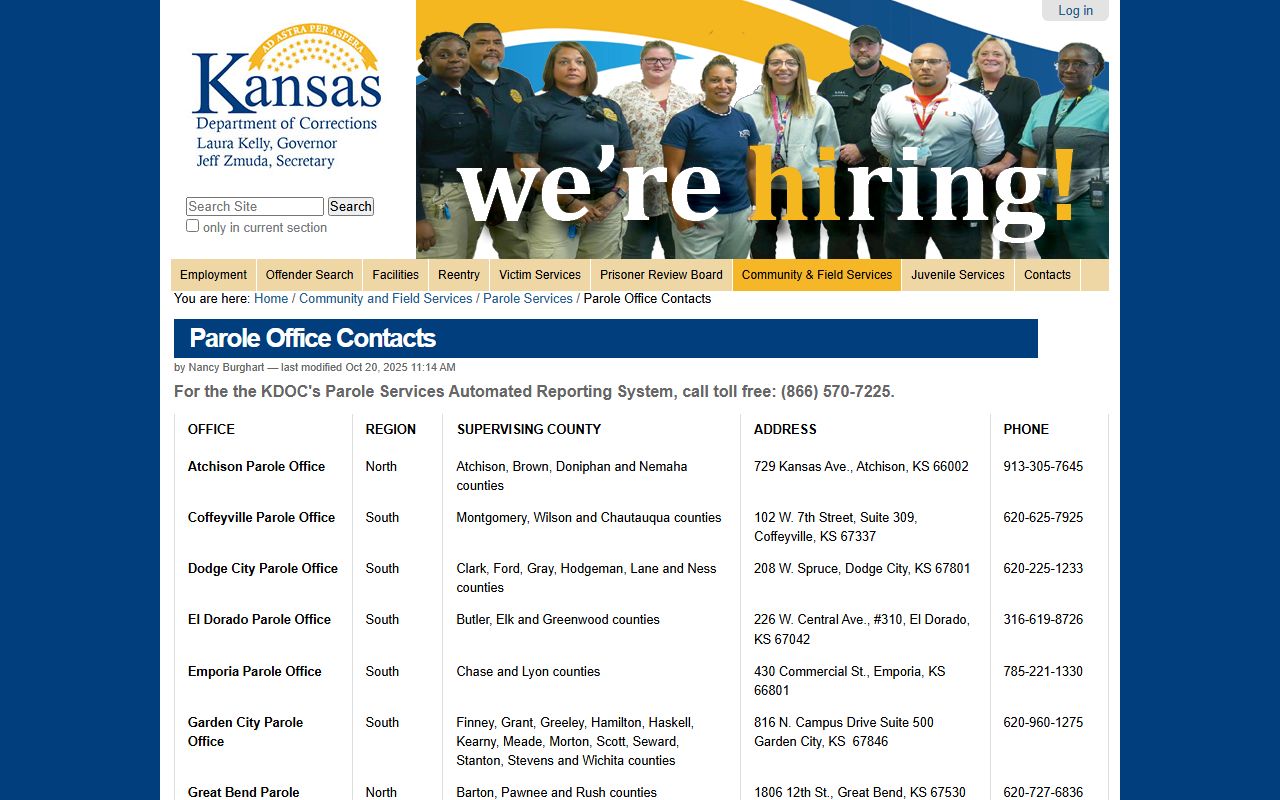
The captured directory confirms Salina as the KDOC contact point for Lincoln County supervision.
Lincoln County Parole Absconders
KASPER provides a dedicated parole-absconder search that can be filtered by last supervision location, including Lincoln County. A separate Community Corrections absconder search covers a different group. The parole results may show a KDOC number, offender name, name type, birth information, age, and an abscond date. These fields help distinguish people with similar names.
An absconder has not completed supervision merely because the person stopped reporting. K.S.A. 75-5217 permits KDOC warrant action and defines absconding around knowing avoidance or making one’s location unknown. Yet the public display is not a live arrest command. KASPER says its information is updated each working day and warns that the page alone is not a basis for arrest. Confirm a current warrant or status through KDOC or law enforcement.
The official search screen shows the county filter and status-focused fields used for a Lincoln County query.
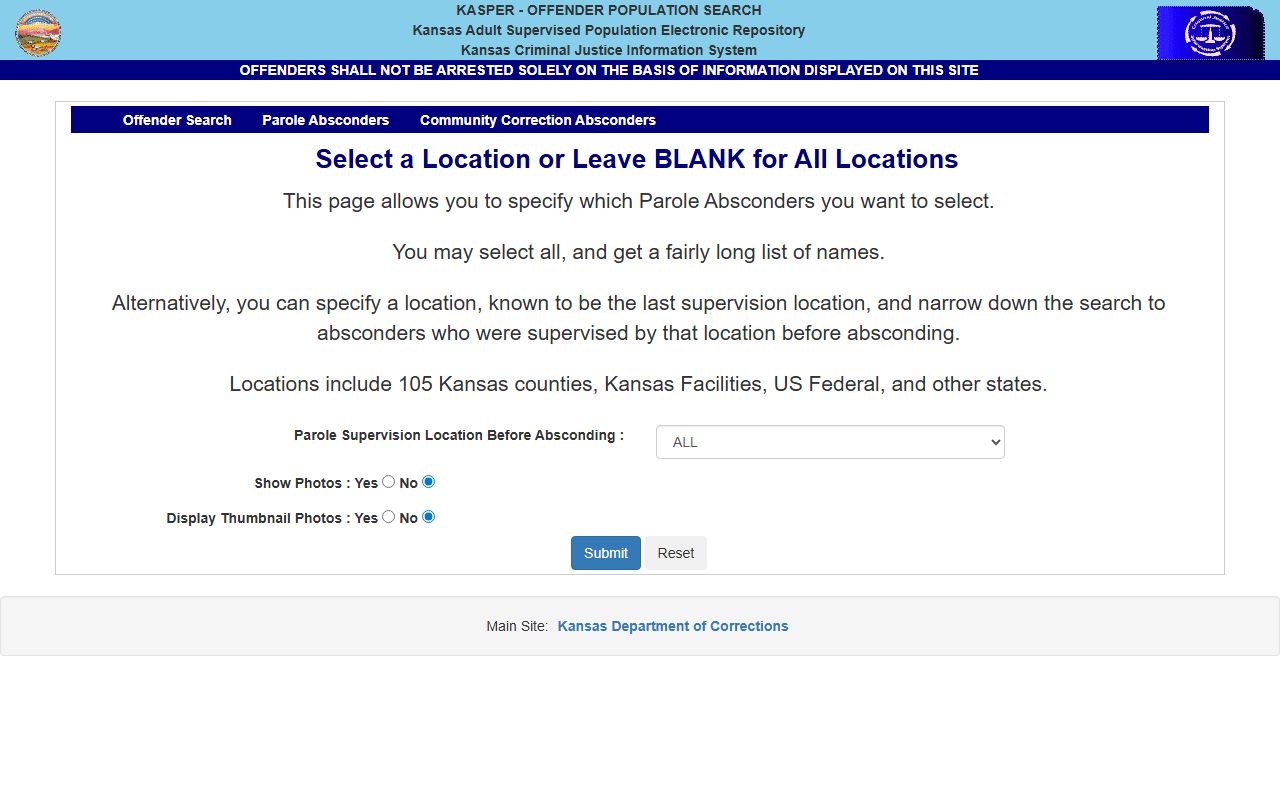
Use the result as a lead, then verify the current agency record before relying on it for any court or safety-related decision.
Lincoln County Parole Hearings
The Kansas Prisoner Review Board handles parole decisions for the parole-eligible population. Modern guidelines prisoners generally move to required postrelease supervision, so not every Lincoln County KASPER record has a parole hearing. The board’s public-comment sessions and dated offender list show a monthly forward-looking cycle. A listed resident is scheduled for a hearing in the following month with possible release in the month after that. This is not a release promise.
Match a listed person by commitment name, KDOC number, county of offense, and case number. Then compare KASPER. After the hearing cycle, request the public decision record from KDOC or the board if no separate results database is available. K.S.A. 22-3717 governs eligibility and includes many sentence-specific exceptions, so the relevant subsection must be tied to the offense date and sentence.
The board process page defines its outcomes. “Parole” is a suitability decision. “Continue” postpones action for more information, deliberation, votes, or evaluation. “Pass” denies parole for a stated period. A grant may still depend on release planning or other holds.
The official hearing list illustrates the monthly schedule and possible release-month language.
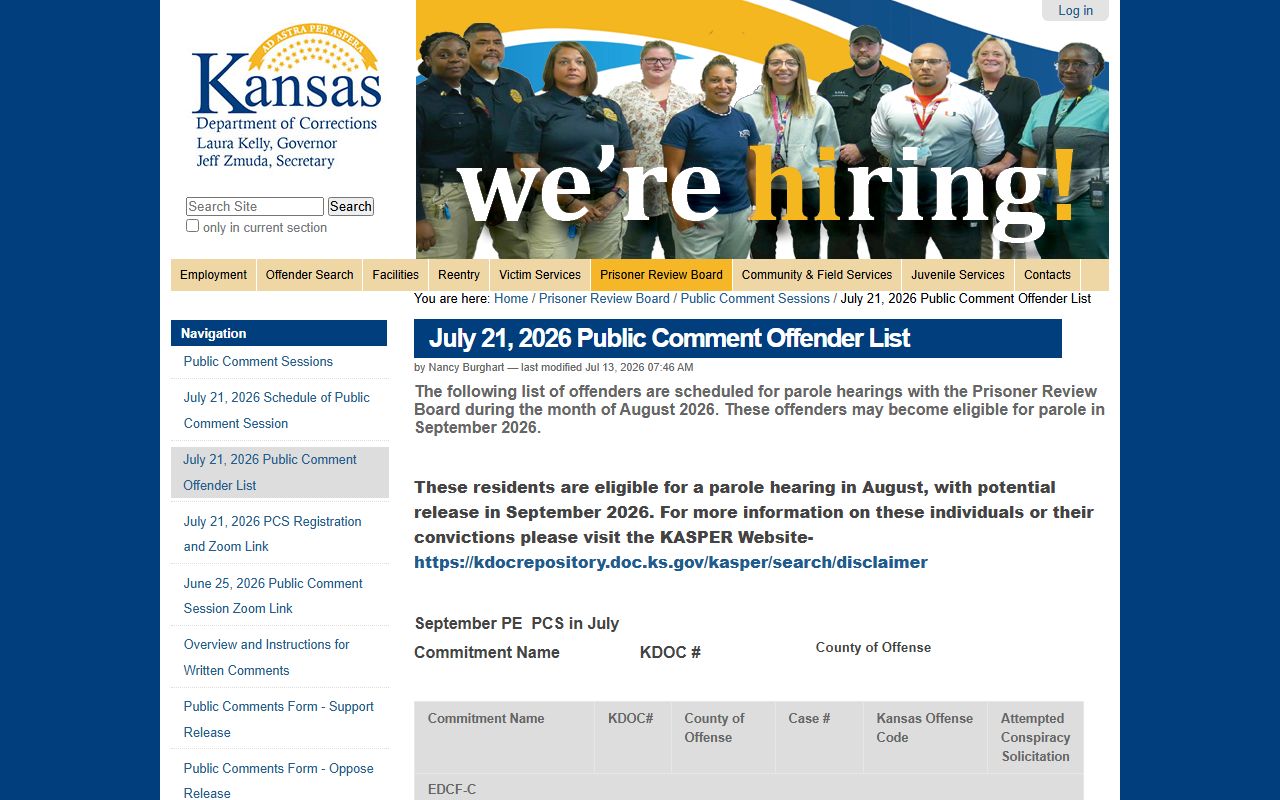
Read the month as a review timetable, not as proof that custody ended.
Lincoln County Probation Gaps
KASPER warns that Community Corrections events after April 21, 2021 may be missing. That limit is crucial for Lincoln County probation verification. A blank or older state display cannot replace the court docket, the signed probation order, or confirmation from the program named in that order. Some people supervised through court services also may have no KASPER record because they never entered KDOC prison custody.
When records conflict, use the stable identifiers. Match the Lincoln County case number, KDOC number when one exists, offense, and order date. Ask the court clerk for the latest termination, revocation, or modification entry. Ask KDOC Records for a releasable sentence-status record when the issue concerns parole or postrelease supervision.
KDOC Central Office is at 714 SW Jackson, Suite 300, Topeka, KS 66603, and its main number is (785) 296-3317. The KDOC contacts material lists the Records Division at (785) 746-7470. A focused request may seek the actual prison-release date and type, the date parole or postrelease began, the last public status, or a maximum-sentence discharge certificate. Request an existing record, not a new explanation or calculation.
Note: A missing KASPER event does not establish that Lincoln County probation ended or that a warrant was cleared.
Lincoln County Supervision Discharge
Prison release, the end of supervision, and expungement are distinct events. A person can leave prison and remain on parole or postrelease supervision. Good time may move the sentence-discharge date, but the applicable law and KDOC record control. Final proof may be a KDOC order, discharge certificate, or public sentence-status record.
Probation ends through the court process. The latest Lincoln County order may show successful termination, revocation, extension, or another disposition. Expungement is a later court remedy for eligible records under Kansas law; it does not itself establish the original release or supervision-end date. If the public portal is unclear, request the actual journal entry rather than inferring from a short docket label.
Conditions and violations also must be read at a high level from the proper order. A violation allegation is not the same as a final revocation. The court decides a probation response, while KDOC and the board handle their respective state supervision processes. A new jail booking can coexist with an unresolved supervision case. Confirm the latest order or agency action before describing the person as discharged, revoked, or returned to custody.
Keep the final document with the identifiers used to find it. A date copied without the status, case number, and issuing office can later be misunderstood. When the public display changes, the signed court order or KDOC discharge record provides the stronger account of how Lincoln County supervision ended.